

Royal Mail parcel sizes and prices: the complete UK guide
19
min read14 October 2026








Royal Mail sorts every UK domestic item into one of four size bands, and the band decides what you pay. Measure things wrongly, even by a few millimetres, and your postage costs can double. This guide sets out the Royal Mail parcel sizes and prices for all four bands, with exact dimensions and weight limits. It also covers how to measure your item and which packaging keeps it in the lower band.
In this article, we’ll cover:
For standard UK post, Royal Mail uses four main letter and parcel size bands: letter, large letter, small parcel and medium parcel. It also has separate rules for tubes and rolls.
Use this Royal Mail size guide for the dimensions, and check current figures against the official price guide before you print labels. Royal Mail publishes the Royal Mail parcel sizes and prices PDF each April.
| Band | Max dimensions (cm) | Max dimensions (mm) | Max weight | Typical contents |
| Letter | 24 x 16.5 x 0.5 | 240 x 165 x 5 | 100g | Greetings cards, postcards, bills, single-sheet documents |
| Large letter | 35.3 x 25 x 2.5 | 353 x 250 x 25 | 750g | A4 documents, paperbacks, slim padded mailers, phone cases |
| Small parcel | 45 x 35 x 16 | 450 x 350 x 160 | 2kg | Books, cosmetics, folded garments, footwear, small electronics |
| Medium parcel | 61 x 46 x 46 | 610 x 460 x 460 | 20kg | Multiple garments, boxed footwear, small appliances, gift sets |
The figures below are Royal Mail’s UK retail prices for postage bought at a Post Office branch, effective 7th April 2026 and checked on 26th August 2026. Online and business-account prices can be lower.
| Format | Weight up to | 1st class | 2nd class |
| Letter | 100g | £1.80 | 91p |
| Large letter | 100g | £3.30 | £1.55 |
| Large letter | 250g | £3.60 | £1.90 |
| Large letter | 500g | £3.60 | £2.40 |
| Large letter | 750g | £3.60 | £2.70 |
| Small parcel | 2kg | £5.45 | £4.25 |
| Medium parcel | 2kg | £8.05 | £6.95 |
| Medium parcel | 10kg | £10.05 | £8.75 |
| Medium parcel | 20kg | £15.45 | £13.15 |
Every price above is a UK Standard retail rate and is exempt from VAT. Both classes include compensation cover of up to £20 as standard.
The band is set by the largest measurement your item breaks, not by what it contains, so a light item in a bulky box is priced on the box. Post Office branches use the same Royal Mail parcel size bands, so a Post Office small parcel is the same format. The post office parcel sizes quoted at the counter are the figures above.
Measure the sealed, packed item rather than the product inside it. Length is the longest dimension, width is the next longest and depth is the smallest.
The figure that matters is the outside of the finished package, including tape, bubble wrap and any void fill. A 340mm document sleeve sits well inside the large letter band, but the same sleeve inside a padded mailer might not.
Tape seams and slight bulging might add 1-3mm to a packed item. That’s enough to push a 24mm package past the 25mm large letter limit and into small parcel pricing.
If you’re choosing packaging rather than checking something already packed, our envelopes and mailing bags interactive tool lets you find the right mailer for you in just a few clicks.
All three dimensions and the weight must fit inside a band, and exceeding any single limit moves the item up a band and up a price.
A 4mm thick item measuring 230mm long can still be a letter. The same item at 6mm thick becomes a large letter, even though nothing else about it has changed.
This is why thickness catches senders out more often than length. The large letter band allows 353mm of length but only 25mm of depth.
Royal Mail doesn’t use volumetric or dimensional weight on standard domestic services. Domestic price is set by size band plus weight, unlike some courier and international services.
For measuring technique on boxed items, our guide to how to measure a box for shipping works through the process step by step.
Royal Mail sets a maximum weight for every band, and two of the four bands split into weight steps that each carry their own price. Letter and small parcel run as a single step.
| Band | Max weight | Weight steps within the band | What the steps mean for cost |
| Letter | 100g | One step, up to 100g | A single price per class, whatever the item weighs up to the limit |
| Large letter | 750g | Four steps: 100g, 250g, 500g, 750g | 2nd class rises at every step; 1st class rises once at 100g then holds flat to 750g |
| Small parcel | 2kg | One step, up to 2kg | A single price per class up to the 2kg limit |
| Medium parcel | 20kg | Three steps: 2kg, 10kg, 20kg | The 10kg to 20kg step is the largest increase in the domestic parcel tariff |
The 1st class stamp weight limit is 100g for a letter and 750g for a large letter, and the 2nd class stamp weight limit is identical. The limit depends on the band, not the stamp. Royal Mail letter weight is capped at 100g whichever class you use, and the large letter weight limit of 750g is the one most senders have room to spare on. Medium parcel weight is the opposite case, where 20kg arrives long before the box is full.
Packaging counts towards the weight, and this is where despatch costings go wrong. Royal Mail weighs the parcel as presented, including the box, the tape and any void fill. A single wall box sized for a small parcel typically adds 200g to 400g before you put anything in it.
A Royal Mail letter measures up to 24 x 16.5 x 0.5cm (240 x 165 x 5mm) and weighs up to 100g. Royal Mail’s letter format also carries a flexibility requirement, so being within those dimensions doesn’t automatically make an item a letter.
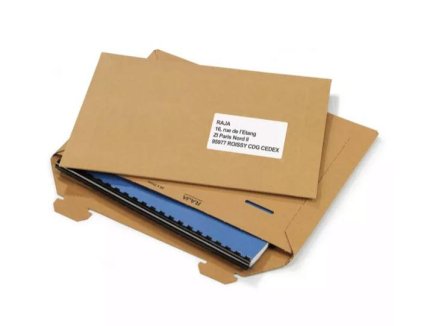
Greetings cards, postcards, bills and single-sheet documents all sit comfortably inside the standard letter size. The 5mm depth limit leaves very little room for padding or bulky contents.
Royal Mail letter sizes are fixed across both classes, so the band is decided by the item and not the service. There’s no separate first class letter size, and the 2nd class letter size matches it exactly.
DL and C5 envelopes both sit inside the letter band when the contents stay under 5mm and 100g. DL measures 220 x 110mm and C5 measures 229 x 162mm, so both clear the 240 x 165mm limit.
The RAJAPACK peel and seal range runs from DL up to C4, and weighs between 2.3g and 20g per envelope. For letter-band post, the letter envelope range is where to start, and the manilla envelope options cover the same dimensions in brown kraft.
The Royal Mail large letter size is up to 35.3 x 25 x 2.5cm (353 x 250 x 25mm) and up to 750g. Unlike the letter band, a large letter can hold rigid items, because the flexibility rule only applies to the letter band.
A4 documents, paperbacks, phone cases, slim padded mailers and flat-packed cosmetics are typical contents. The large letter dimensions give you plenty of length and width, and almost every issue happens due to misjudging the depth.
Two paperbacks stacked together will usually break 25mm, while one in a slim mailer often won’t. That single measurement is the difference between large letter and small parcel pricing.
There’s also a delivery benefit. A large letter that fits through a standard letterbox can be delivered without anyone being home, which cuts failed deliveries. That makes the 25mm limit worth designing around twice over, for the band and for first-time delivery.
Rigid-backed envelopes are built for this band, holding A4 flat at well under 25mm. RAJAPACK do not bend envelopes protect prints and certificates without adding depth, and the wider board backed envelopes range covers larger formats.
For contents that need protecting, a4 padded envelopes and bubble envelopes both sit inside the band in their slimmer sizes. Check the packed depth rather than the stated internal size, because padding adds to the outside measurement.
For flat, unpadded post, an a4 envelope in C4 format measures 324 x 229mm, clearing the 353 x 250mm limit with room to spare.
Large letter postage cost is set in four weight steps: up to 100g, up to 250g, up to 500g and up to 750g. The two classes behave differently across those steps, which catches people out.
2nd class large letter postage rises at every step, from £1.55 at 100g to £2.70 at 750g. A 101g item costs 35p more than one at 100g, so weighing matters as much as measuring.
The Royal Mail large letter price works differently on 1st class large letter post. It rises once, from £3.30 to £3.60 at the 100g mark, then holds at £3.60 all the way to 750g. If you send 1st class, there’s no cost reason to shave grams above 100g.
The gap between the classes is widest at the bottom of the band and narrows as the item gets heavier. At 100g, 1st class costs more than twice 2nd class, while at 750g the difference is 90p.
Envelope format alone doesn’t decide the band, because depth and weight matter just as much. The table below shows where each common size starts.
| Envelope size | Dimensions (mm) | Band it starts in | What the band then depends on |
| DL | 220 x 110 | Letter | Stays a letter under 5mm and 100g |
| C5 | 229 x 162 | Letter | Stays a letter under 5mm and 100g, and holds A5 flat |
| A5 board-backed | 229 x 162 | Large letter | Rigid backing breaks the letter flexibility rule |
| C4 | 324 x 229 | Large letter | Clears 353 x 250mm, so depth and weight decide the price step |
| A4 board-backed | 324 x 229 | Large letter | Holds A4 flat at well under the 25mm depth limit |
| A3 cardboard | around 330 x 450 | Small parcel | The 450mm length exceeds the 353mm large letter limit |
The C4 envelope dimensions of 324 x 229mm clear the 353 x 250mm limit, so the band comes down to packed depth and weight. Posting A4 documents flat in a C4 envelope keeps the a4 envelope postage cost inside the large letter band. C5 envelope postage sits in the letter band while contents stay under 5mm.
An A3 cardboard envelope catches people out. At around 450mm long it breaks the 353mm length limit, so a3 envelopes are priced as a small parcel however thin and light they are.
Post office envelope sizes are the same bands applied at the counter. There’s no separate first class envelope size, so the envelope sizes Royal Mail recognises hold whichever service you buy. A5 envelope postage depends on whether the envelope is plain or board-backed.
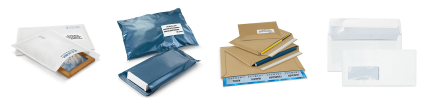
The Royal Mail small parcel size is up to 45 x 35 x 16cm (450 x 350 x 160mm) and up to 2kg. It’s the workhorse band for e-commerce despatch, and the 2kg limit is firm on standard services.
Books, cosmetics, folded clothing, footwear and small electronics are the typical contents. The Royal Mail small parcel dimensions give you 450 x 350 x 160mm to work with. That 160mm depth is more than six times the large letter allowance.
Weight is what usually trips people up here. A box filled to the full small parcel size will exceed 2kg way before it runs out of room, particularly with books or glassware.
Polythene and paper bags cover most of this band. RAJAPACK mailing bags run from 175 x 230mm up to 850 x 1050 x 40mm. The mid sizes sit inside the small parcel band, and the largest suit flat medium parcel items.
For anything needing cushioning, a jiffy bag adds protection while staying inside the band in its mid-range sizes. Padded bags add depth, so check the packed measurement against the 160mm limit.
Rigid contents are better sent in a small parcel box than a bag, because a box holds its shape under load. Bags flex around the contents, which helps on depth but risks damaging anything fragile.
Royal Mail small parcel price runs as a single weight step up to 2kg, at £5.45 1st class and £4.25 2nd class. That makes small parcel postage simpler to work out than large letter, which has four steps.
The step up from large letter is where things jump up in price. A 400g item costs £2.40 as a 2nd class large letter and £4.25 as a small parcel. That’s £1.85 more for the same product, for the sake of a few extra millimetres.
The Royal Mail medium parcel size is up to 61 x 46 x 46cm (610 x 460 x 460mm) and up to 20kg. It’s the largest standard domestic format Royal Mail offers.
Multiple garments, boxed footwear, small appliances and gift sets all fall inside the medium parcel dimensions. The 20kg allowance is 10 times the small parcel limit.
Most senders run out of weight before they run out of space. A 610 x 460 x 460mm box holds around 129 litres, which is a huge volume to fill before you reach 20kg.
The 46cm depth allowance is nearly three times the 16cm small parcel limit, which is why this band takes bulky goods like boxed footwear and multi-item orders.
Larger cardboard mailers cover the flat end of this band, running up to 715mm across the RAJAPACK range. They suit framed prints, artwork and anything wide but shallow.
Flat-format shipping bags in the largest sizes also work here, at up to 850 x 1050 x 40mm. For contents with real depth, a box is the practical option, and boxes for posting rigid items sit in the postal boxes range rather than this one.
Royal Mail medium parcel price is set in three weight steps: up to 2kg, up to 10kg and up to 20kg. The step from 10kg to 20kg is the largest single increase in the domestic parcel tariff, adding £5.40 on 1st class and £4.40 on 2nd.
Splitting an order is occasionally cheaper, but not always: a 12kg consignment costs £13.15 as one 2nd Class medium parcel, against £17.50 for two 6kg medium parcels. Compare both before assuming either way.
There is no Royal Mail large parcel band for standard UK domestic post. Anything above 61 x 46 x 46cm or 20kg generally needs Parcelforce Worldwide or another carrier.
Plenty of senders still search for a Royal Mail large parcel size, expecting a fifth band. It doesn’t exist under Royal Mail’s domestic formats, but Parcelforce does publish limits for anything larger.
Parcelforce accepts UK parcels up to 30kg, with a maximum length of 1.5m. Its standard domestic services also cap length plus girth combined at 3m, where girth is twice the width plus twice the height.
If your item breaks the medium parcel limit on any dimension or on weight, your options are Parcelforce, another carrier or repacking into two medium parcels. Two parcels only beat one Parcelforce consignment when both are light.
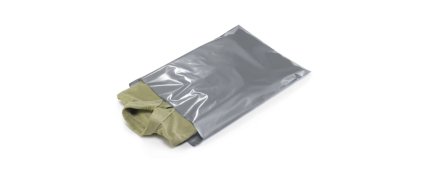
Aim for the lowest band your product will safely fit, because the price gaps between bands are far wider than the gaps within them. For most senders there’s a lot of value in getting items out of small parcel and into large letter.
The large letter limit at 25mm of depth is where the savings hide, and anything that keeps a packed item under it pays back on every despatch.
The published rates put a figure on each band gap. On 2nd class, dropping from small parcel to large letter at the top of each band saves 36%, and dropping from medium parcel to small parcel saves 39%.
The largest proportional saving of all sits at the bottom. A 100g item posted as a letter rather than a large letter costs 41% less, though the 5mm depth limit means few products qualify.
The second-most valuable boundary is the 2kg small parcel weight limit. Lighter packaging materials buy you more product weight inside the same band, which matters most on heavy lines like books and hardware.
Since 7th April 2026, Royal Mail applies an £11 per item correction charge to Tracked 24 and Tracked 48 return items that exceed the medium parcel limits. The thresholds are 20kg, 129 litres of volume or 610 x 460 x 460mm.
This is a returns charge rather than an outbound one, so it lands on items coming back to you. Oversized returns are scanned and charged at that flat rate per item.
Royal Mail parcel sizes and prices come down to one process: measure the packed item, then choose packaging that holds it inside the band you want. The dimensions rarely change, but Royal Mail regularly reviews its prices.
Choosing parcel packaging that matches the band is the difference between paying letter rates and parcel rates on the same product. If you currently buy post office packaging at the counter, ordering the right sizes in bulk removes the guesswork.
Weigh and measure a packed sample of your typical order before committing to a packaging line. It’s the fastest way to find out whether you’re paying small parcel rates on a large letter product.
Browse the RAJAPACK range of mailers to find envelopes and bags sized to each Royal Mail band, with next-day delivery on stocked lines.
A standard adult shoe box measures around 33 x 20 x 12cm, which fits inside the 45 x 35 x 16cm small parcel limit. It qualifies as a small parcel provided the packed weight stays under 2kg.
An A5 envelope at 229 x 162mm sits inside both the letter and large letter dimensions, so the band depends on depth and weight. Under 5mm and 100g it’s a letter, and above either figure it becomes a large letter.
The four main letter and parcel bands and their dimensions are the same, but prices and some service limits can vary between Post Office counter, online and business-account postage.
Royal Mail can check an item’s dimensions and weight, and items that don’t match the postage paid may attract additional charges. Standard domestic pricing doesn’t use volumetric weight.
Yes, any packaging is acceptable if the packed item fits the band dimensions and weight and is sealed securely. Royal Mail doesn’t require branded packaging for standard domestic services.
A padded envelope is rarely a letter, because the padding usually takes the packed item past the 5mm depth limit. Slim padded mailers normally fall into the large letter band instead.
Royal Mail regularly reviews its prices and can change rates and surcharges. The current retail prices in this guide took effect on 7th April 2026.