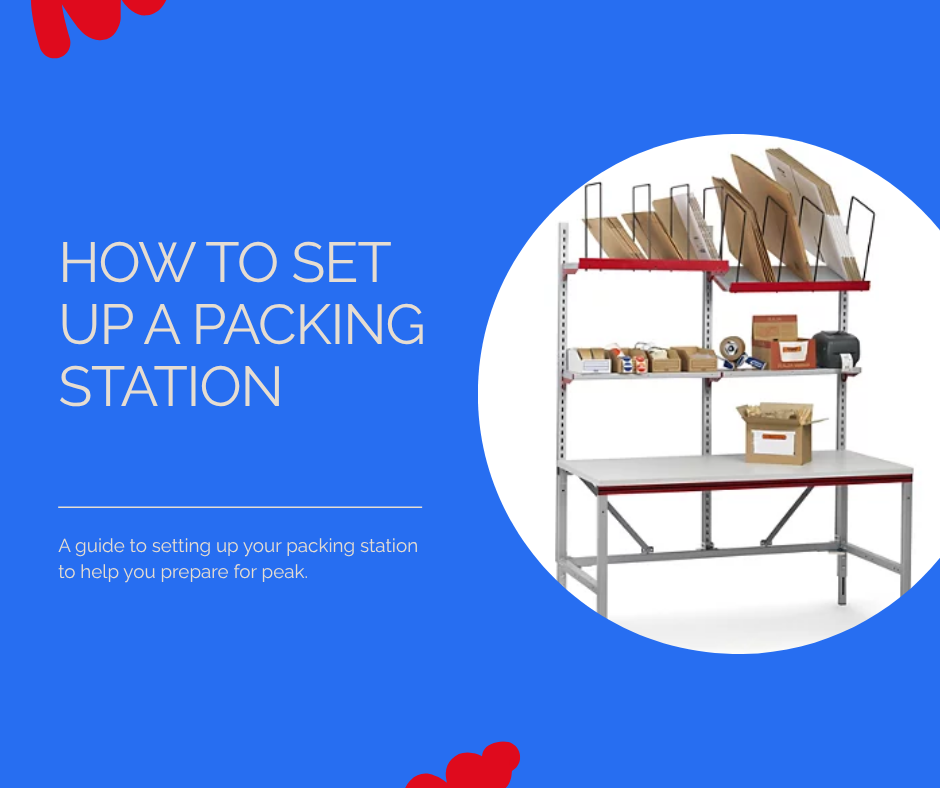
How to set up a packing station: a UK guide to small-space and high-throughput setups
16
min read01 September 2026








Setting up a packing station well comes down to one thing: cutting the number of times a packer has to reach, turn or walk during a single order. Get the layout, the bench height and the kit right, and you pack faster, damage fewer parcels and put less strain on the people doing the work.
This guide is for warehouse and e-commerce operations of any size, including the many that must fit a working station into a corner rather than a purpose-built bay. Below we cover how to set up a station from an empty bench upward, whether that’s a station for e-commerce despatch or a busy trade counter. We pay real attention to small spaces and shift-friendly ergonomics.
In this article, we’ll cover:
A packing station is the dedicated workspace where picked goods are checked, packed, weighed, labelled and made ready for despatch. It sits between picking and the outbound area, and it’s where most of the value in a fulfilment operation is either protected or lost.
The three terms people use interchangeably aren’t quite the same. A packing bench is the work surface itself. A packing station is that bench plus everything built around it: shelving, dispensers, scales and a screen. A workstation is the broader term for any equipped work position, packing or otherwise.
For most operations, the station is what you’re setting up. The bench is just the starting point.
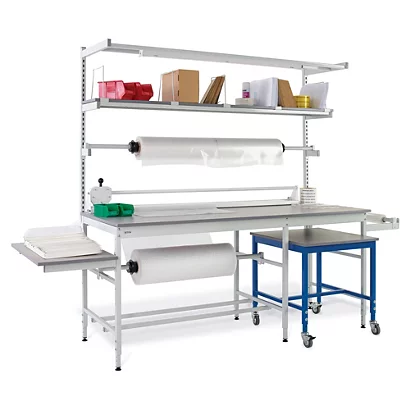
A working station needs seven core items: a right-height work surface, consumables within reach, anti-fatigue matting, dispensers, scales and a printer, lighting and a waste route.
What equipment do you need for a packing station? Less than most catalogues suggest. Start with the items below, in the order they earn their place on the bench:
The pattern across all seven is the same. Keep everything the packer needs within a single arm’s sweep, and give waste somewhere to go. Anything that forces a turn or a walk is a cost you pay again on every order.
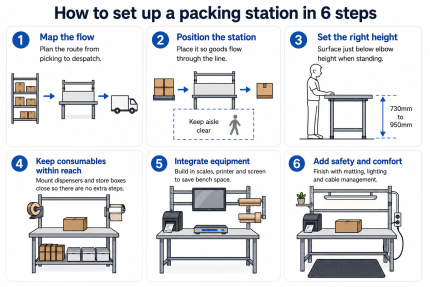
Here’s how to set up a packing station in six steps, from picking flow through to cable management. The order matters: fix the flow and the height first, then add the kit that sits on top. In Lean terms, everything below is about removing motion waste: the extra reaching, turning and walking a packer repeats on every order.
Before you place a single bench, walk the route an order takes from pick face to outbound. The station belongs where that line naturally passes, not where there happens to be a spare corner. Mapping the flow first stops you building a bottleneck you then have to work around.
Site the bench so picked goods arrive on one side and finished parcels leave on the other. A packer who carries a sealed parcel back across the floor is doing unpaid steps on every order. On a shared line, keep a clear aisle behind the benches so restocking never crosses the packing flow.
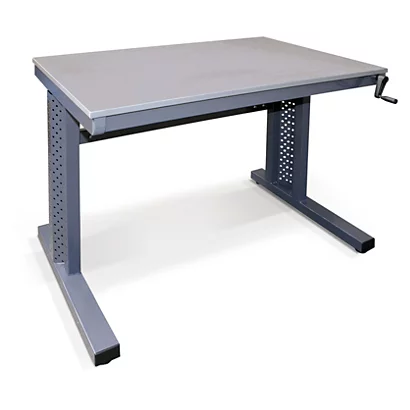
Set the surface just below the operator’s elbow when standing. For a station shared across shifts, a height-adjustable bench matters more than anything else on the list. The light-duty height-adjustable workbenches crank from 730mm to 950mm by hand, so one bench suits operators of different heights without tools.
Mount tape and void-fill dispensers on the bench uprights, and keep boxes in under-bench storage. The goal is that the packer’s feet stay planted while their hands do the work. If reaching for the next box means a step, the layout isn’t finished.
Build the scale, label printer and monitor into the station rather than crowding them onto the worktop. The RAJA Modular packing stations include PC and monitor supports and two dispenser bars as components, so the electronics mount into the frame instead of eating bench space.
Finish with anti-fatigue matting, task lighting and cable management. These feel optional until week three of peak, when fatigue and trip hazards start showing up in your error rate and your accident log.
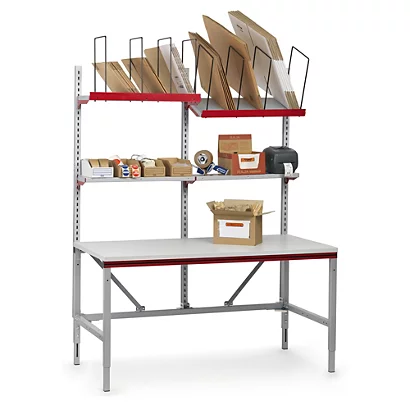
If you’d rather not build from parts, the RAJA Basepack packing station is a fixed 1600mm bundle rated to 100kg on the work surface, ready to use. The RAJA Modular packing stations let you configure the same idea from thirteen components as your volumes grow.
In a small space, build upward and store underneath. A compact station uses vertical shelving above the worktop, under-bench storage below, and mobile units that fold or wheel away so the footprint flexes for peak.
The most common constraint we hear from small businesses and e-commerce sellers isn’t budget, it’s floor space. A small station has to do everything a large one does inside a metre or two of bench.
Three warehouse station ideas work reliably in tight footprints. First, go vertical: put shelving and dispensers above the worktop so the wall does the storage work, not the floor. Second, store underneath, using under-bench storage units to hold consumables without adding footprint. Third, stay mobile: wheeled workstands let you pull a second station out for peak and roll it away in January.
The RAJA Modular packing stations help here because you can configure them narrow, on a 1600mm table rather than 2000mm, and keep dispensers and a screen. For an operation that flexes hard between quiet and peak, a repositionable mobile workstation beats a fixed bench you can’t move.
As a rough guide, a single 1600mm bench with vertical shelving above and two under-bench cupboards below will handle a surprising throughput before you need a second station.
The most efficient layout minimises touches and moves each order in one direction. Everything the packer needs sits within arm’s reach, and the station sits between picking and despatch so no one walks to restock or to carry a parcel away.
Knowing how to organise a station comes down to five zones on and around the bench:
Laid out this way, an order flows across the bench in one direction and never doubles back. The work surface stays clear because consumables live on the uprights and under the bench, not on top. Waste leaves without a walk.
If you run 5S, this is set in order applied to a bench: every consumable has a marked home at its point of use.
The reason this matters is touch count. Every extra reach, turn or step repeats on every single order, so a packing station layout that saves two seconds per parcel saves real hours across a peak week. A configurable bench earns its place here. The modular options in our range let you move dispenser bars and shelves until the flow is right, rather than work around a fixed design. For heavier assembly-style packing, the square tube workbench kits carry up to 250kg on the surface and take a louvred back panel for bins and tools.
Set the work surface just below the operator’s elbow when standing, add anti-fatigue matting, and raise the screen to eye level. For a station shared across shifts, a height-adjustable bench is the single most useful ergonomic feature you can fit.
Repetitive packing loads the back, shoulders and wrists, and the scale of that problem across Great Britain is large. According to HSE, an estimated 511,000 workers had a work-related musculoskeletal disorder in 2024/25, making up 27% of all work-related ill-health cases and second only to stress. Those disorders accounted for 7.1 million working days lost.
The same HSE data shows the back accounts for 43% of those cases and the upper limbs or neck for 41%. Both posture and reach therefore matter at a packing bench. Handling, lifting and carrying is also the second most common cause of non-fatal workplace injury reported to HSE, at 17% of the total. These are GB-wide figures on the scale of the problem, not a claim about any single product.
An ergonomic packing station setup starts with height. A surface that’s too low bends the back; too high, and the shoulders carry the load all shift. Just below standing elbow height keeps the wrists neutral. The height-adjustable workbenches adjust from 730mm to 950mm by hand crank, so a station shared by a morning and an afternoon operator can suit both.
If your team packs to a fixed, repeatable sequence, RAJAPACK key account managers can spec the bench around that standard work. They set the height to the operator, seated or standing.
Then add matting and sort out screen height. The COBA Orthomat Diamond anti-fatigue mat is 9.5mm of open-cell PVC foam with bevelled edges, so trolleys roll straight over it. It cuts the standing fatigue that builds through a shift. Raise the monitor to eye level on an arm so the neck stays neutral rather than dropping to a screen on the worktop.
A mat laid on the benchtop cushions hands and elbows, and gloves, hi-vis and safety footwear finish the setup on a busy line.
Scales, label printers, monitors and scanners all need power and data without cluttering the worktop. Route cables off the surface, house the PC in a cupboard, and mount the monitor on an arm.
It’s increasingly a small IT setup as well as a bench, and the worktop has to stay clear for packing. That means the electronics need a home of their own. A computer cupboard keeps the PC off the surface and out of the dust, while a monitor arm frees up the space a screen on a stand would take.
Cable management is the unglamorous part that pays off daily. Loose cables across a worktop snag parcels and collect tape offcuts; run underneath the bench, they disappear. The RAJA Modular packing stations include PC and monitor supports as components, so the equipment mounts into the frame rather than competing with the packer for bench space.
Choose a fixed bundle if you want zero decisions. Choose modular if you want to reconfigure as you grow, or a turnkey kit for a fully specified station out of the box. For very high loads or bespoke lines, a specialist supplier is the honest answer.
The RAJA Basepack packing station is the no-decisions option: a fixed 1600mm bench rated to 100kg on the work surface, ready to go. The RAJA Modular packing stations suit operations that expect to change, letting you add shelves, dispenser bars and supports from thirteen components as volumes rise. If you’d rather buy a complete high-spec station in one go, the packing station kit and the version with an under-bench table arrive fully specified.
Be honest about where RAJAPACK isn’t the right fit. For surface loads well above 100kg or premium German ergonomics, the Hudig-Rocholz System Flex range is built to around 300kg. Where you need ISO 9001:2015 manufacturing with antibacterial paint, the Pack Tek workbench kits carry Germ Guard coating for hygiene-sensitive packing. And for 50 or more bespoke stations, or anything involving conveyor, that’s a design conversation rather than an off-the-shelf order, which is what RAJA Projects is for.
Trying to win every job helps no one. A packer on the wrong bench is a problem you’ll be fixing for years. Point heavy or specialist buyers to the right supplier from the start.
The most common mistakes are all layout mistakes. Packers end up with consumables out of reach, benches sited away from the pick flow or a surface fixed at one height for a shared team. Each one repeats on every order.
The theme is familiar. Most of these mistakes come from treating the bench as furniture rather than as a workflow. In Lean terms they are motion, transport and waiting: waste paid again on every order. Fix the flow, the height and the reach, and the rest of the station falls into place.
The fastest route to a working packing station is to fix the flow and the height first, then add kit. Layout and bench height decide how quickly and how safely the station runs. Dispensers, scales and screens are refinements on top of that.
If you’re setting up your first station, start with one well-configured bench in the right place and build from there. If you’re planning for peak, work out where a second, mobile station would go before you need it. Either way, the bench you can adjust and reconfigure will serve you longer than the one you can’t.
Not sure which bench suits your setup? Kit out one bench, measure the gain, then scale. Browse the RAJAPACK range of packing benches to compare fixed, modular and height-adjustable options before you commit.
The packing area is the zone between picking and despatch where orders are checked, packed, weighed and labelled. It’s typically laid out as a row of packing stations positioned so goods flow from picking through to the outbound bay.
Store boxes flat-packed by size in labelled under-bench or vertical shelving, with the fastest-moving sizes closest to the packer. Keeping the two or three most-used sizes within arm’s reach cuts the walking that slows a packing line.
Packaging is usually grouped into three levels: primary, which touches the product; secondary, the outer box or mailer; and tertiary, the pallets and stretch film used for transit. A packing station mostly handles secondary and tertiary packaging.
A single station works in as little as 1600mm of bench width, plus room for the packer to stand and turn. Building storage vertically and under the bench keeps the floor footprint to roughly two square metres.
Most warehouse packing is done standing, because it allows more reach and quicker movement between tasks. Standing stations should use a height-adjustable bench and anti-fatigue matting to reduce the strain of a full shift.
Yes: a packing station setup is 5S applied to a bench, where sorting clears out what you no longer use. Set in order then gives every consumable a marked home within reach, and shine keeps the work surface clear so nothing is hunted for mid-order.