
Prepare for peak season: see what your operation could save
9
min read01 October 2026








Our new Prepare for Peak tool puts a number on what faster packing, less material and freed floor space could save you this peak and across the year. Most businesses prepare for peak season by ordering more stock and lining up extra hands. Few work out what a few seconds and pennies on every parcel add up to at peak volume. This first-of-its-kind tool does that maths for you, using your own volumes and pack times.
Learn all about what it can show you below, or try out our prepare for peak savings calculator right now.
The Prepare for Peak tool is a free online calculator from RAJA. It estimates the labour, material, storage and absence savings you could make by changing how you pack, before, during and after peak.
It’s built for operations, despatch and e-commerce managers who run a pack line through the busiest weeks of the year. It’s designed to help you prepare for peak season with real numbers, not just flaky guesswork, and you don’t need a forecast or a finance background to use it. All you need a rough idea of your daily orders and how long a typical parcel takes to pack.
Every result is an estimate, not a quote. But, it uses real data to show you where the money sits, so you can decide which changes to make first. It works alongside our wider playbook for e-commerce peak season, which covers the timeline and the places peak pressure shows up.
The calculator measures seven levers, with each one representing a change to your pack line or warehouse. You only switch on the levers that apply to you, and the tool adds up the saving from each in both pounds or time, whichever one is more important to you.
Most of the levers save time, which our guide to packing efficiency explains in more detail. Others save material, and one saves floor space. But, as the old saying goes, time equals money, so you can see the direct savings impact even just one small change can make.
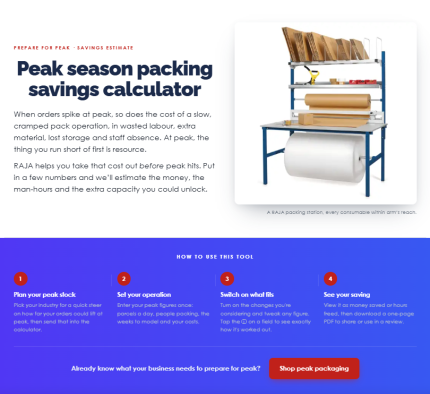
A bench laid out so the packer never turns or walks mid-order recovers seconds on every parcel. The tool prices those seconds at your labour rate. If you’re starting from scratch, our guide on how to set up a packing station covers layout and bench height.
A crash-lock base locks with one press, so only the top needs taping. The tool calculates the time saved from your own current pack time rather than a fixed figure. That way, a team that already packs quickly doesn’t get an inflated result for switching to crash-lock boxes.
A single strip of gummed paper tape seals a box in one go. An automatic tape dispenser measures and wets each strip to length, so the tool counts both the sealing time saved and the tape you no longer waste on repeat passes.
Void fill made at the bench removes the trip to fetch pre-made cushioning and the habit of over-filling. The tool compares your current material with paper from a paper void fill machine, produced in the amount each parcel needs.
Pre-made void fill is mostly air, and you pay rent to store it. The tool works out the floor area that flat paper stock gives back, then prices it using UK warehouse rent data. Our guide to warehouse space optimisation shows how to put that reclaimed space to work at peak.
Packers who stand on concrete all shift get tired faster, and fatigue can lead to errors and absence. The tool estimates the cost of absence using CIPD data, then shows what anti-fatigue mats at fixed stations could save.
Pre-stretch pallet wrapping uses less film per pallet without weakening the load. In a RAJA machine trial on a 1,000 × 1,200mm pallet, film use fell from 527g to 286g while containment force rose from 18kg to 21.5kg. The tool uses trial data like this to estimate your film saving from the pallets you wrap and the rolls you use each week.
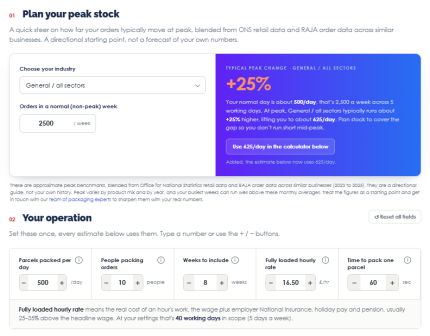
The built-in peak planner gives you a starting uplift for your sector, so you don’t need your own forecast to begin. It covers 12 major sectors, with figures blended from ONS retail data and our own order data.
Choose your sector and the planner suggests how much busier your peak weeks are likely to be than a normal week. For businesses that handle peak trading periods without a formal forecast, that’s often enough to see which levers matter most.
It’s a directional figure, not a prediction. If you have last year’s daily volumes, use those instead. Our guide to peak inventory planning shows how to build a baseline and a buffer from your own history.
Using the calculator only takes minutes, and you’ll get the most from it with a couple of numbers to hand. Work through it in this order:
If you’re using it to prepare for peak season, run it in September or October, so there’s time to order stock and set up benches before volumes climb. If you’re not sure of a figure, start with the default and adjust it later. Switching levers on and off shows you which change moves the total most.
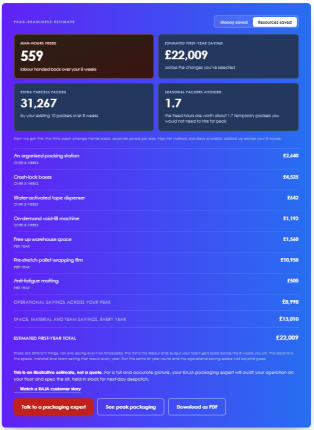
You get a results grid showing what your chosen changes could save, split between your peak weeks and the rest of the year. It also shows how many seasonal packers the time savings could replace.
That split is useful for your peak season strategy. A change that pays back within peak is an easy decision. One that pays back over a full year can still be worth making before peak, because the saving carries on once volumes settle.
Enter your email address and the tool produces a PDF report you can share with your team or finance director. The report carries the same caveats as the tool, so nobody mistakes an estimate for a quote.
The tool’s job is to show you where the money is before peak arrives, not after. Once you know which levers carry the biggest saving, you can plan the changes, order stock and brief your team with a clear reason for each.
That’s a sounder way to prepare for peak season, and to plan your peak season logistics, than instinct alone. The figures are a starting point, and a RAJA packaging expert can check them against your real operation.
See what faster packing, less material and freed floor space could be worth to your operation this peak. Use the prepare for peak tool now and see how your business can get ready for the busiest time of the year.
Yes. You can run the calculator for free, and you only need to give an email address if you want the PDF report.
Yes. The savings scale with your volume, so a single-bench operation sees smaller totals, but the tool still shows which changes pay back fastest.
Because most peak savings are measured in seconds per parcel. Your pack time tells the tool how much time each change can realistically recover.
Replace them. The defaults are there to get you started, and your own numbers will always give a closer estimate.
Yes. The levers apply to any operation that packs parcels or wraps pallets, whether orders go to consumers or trade customers.
It models product types such as crash-lock boxes and on-demand paper void fill, based on real RAJA products and pricing. A packaging expert can then match specific products to your parcels.
Rerun it whenever your volumes or pack process change, and again before each peak. That keeps the estimate in line with how your operation actually runs.
Every figure in the tool comes from a named source: RAJA’s own data or published UK data. You can see where each assumption starts, and change it where your own number is different.
Our data covers product testing, such as crash-lock assembly timing, and order data from similar businesses. It also includes real product pricing, including RAJA EcoWrap film and pre-stretch wrapping machines.
Published sources include ONS retail data for sector uplift, GOV.UK for labour rates, CIPD for absence and Cushman & Wakefield for warehouse rent. Material and film ratios come from Ranpak and Robopac, the manufacturers behind the paper and pallet-wrapping equipment.