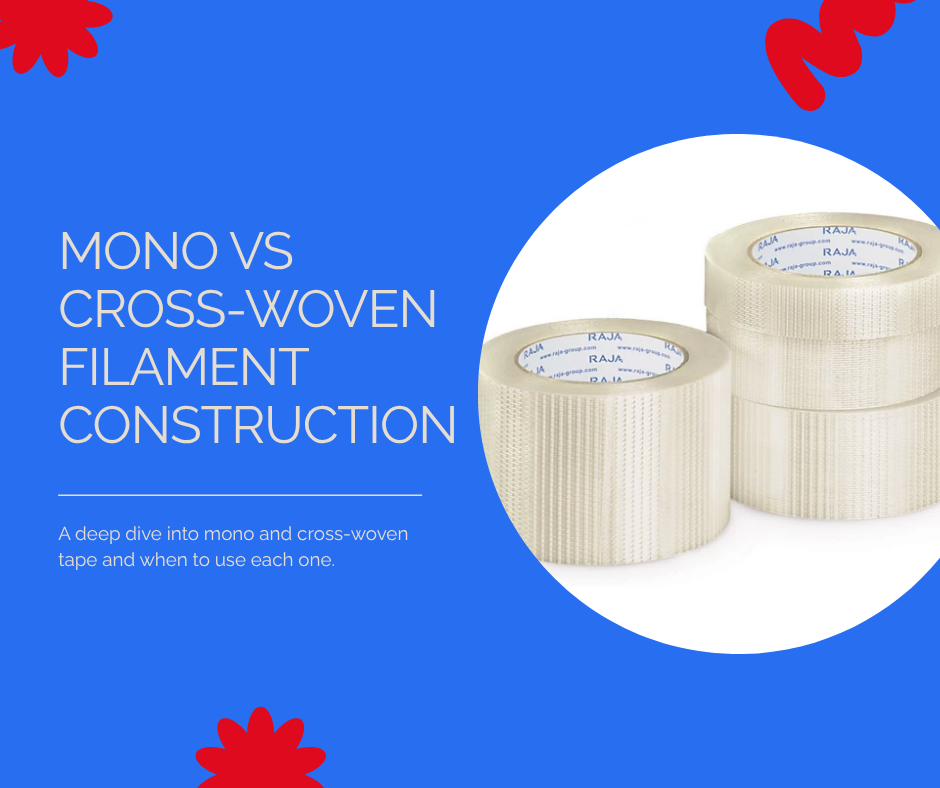
Mono vs cross-woven filament construction: when to use each
8
min read22 May 2026








Filament-reinforced sealing options use embedded glass fibres for added strength, but the two main constructions – mono and cross-woven; are designed for different load types. Choose the wrong one and you’re either over-specifying for the job or leaving your load without support in the direction it actually needs. This guide explains the difference and helps you find the right type for your application. For the full specification of options, see the industrial tape range.
In this guide, we’ll cover:
Mono filament refers to a pressure-sensitive option with continuous glass fibre strands embedded in the backing, running parallel along the length of the roll. These fibres give very high tensile strength in a single axis. The tape resists pulling forces along its length with considerably more force than standard polypropylene tape.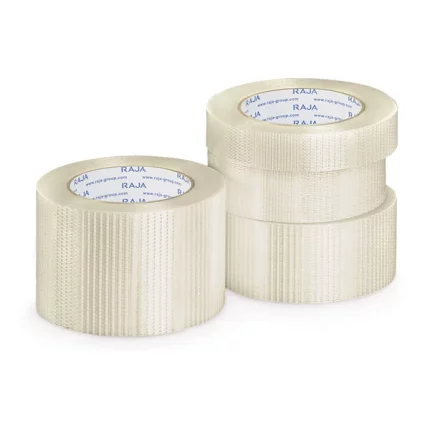
The backing in the RAJAPACK range is polypropylene with an artificial hot melt rubber adhesive. The mono filament option has a 90 micron total thickness, which is thin relative to the load it can hold, the strength comes from the fibres rather than the film.
Filament-reinforced sealing can’t be torn by hand because of the continuous fibre construction. It requires a cutter, scissors or a dispenser with an integrated blade. For high-volume packing lines, a dispenser with a built-in cutter is the standard setup.
Cross-woven adds a second axis of reinforcement: fibre strands run both along the length of the tape and across its width, creating a woven grid pattern in the backing. This bi-directional reinforcement gives strength in both axes simultaneously, which mono construction doesn’t have.
The woven structure means the option resists tearing in both directions and can handle loads that apply stress at angles or across irregular surfaces. It’s physically thicker than the mono construction due to the two-layer fibre structure – 110 microns total thickness in the RAJAPACK range. Tensile strength is rated separately in the machine direction and the cross direction in the product data sheet.
The key difference is the axis in which the strength is applied. Mono construction has very high tensile strength along its length but minimal cross-direction tear resistance. Cross-woven has strength in both directions but typically a lower peak rating in either single axis compared to a mono option of the same width.
The cross-woven option isn’t ‘weaker’; it distributes its strength across two axes, which is what makes it suited to multi-directional loads. For specific tensile strength figures in machine and cross directions, check the product data sheet – these are rated per product and vary by width and gauge.
The following table summarises the two constructions across the factors buyers usually face:
| Factor | Mono construction | Cross-woven construction |
| Fibre direction | Single axis (along the length) | Two axes (length and width, woven grid) |
| Peak strength | Highest in machine direction | Distributed across both axes |
| Tear resistance | Resists pulling along length only | Resists tearing in both directions |
| RAJAPACK product | Polypropylene Mono Filament (90 micron) | Polypropylene Filament (110 micron) |
| Available widths | 25mm, 48mm | 25mm, 48mm, 75mm |
| Roll length | 50m | 50m |
| Weight band | Above 30kg | Above 30kg |
| Hand-tearable? | No, requires a cutter | No, requires a cutter |
| Best load type | Long, regular loads with single-axis stress | Irregular loads with multi-directional stress |
Mono is the right choice when load stress is applied consistently in one direction and that direction aligns with the tape’s length.
The most common applications include securing goods along their length and strapping loads to pallets where the strap runs in a single plane. Reinforcing box bases under downward compression in a stack is another common use. In all these cases, the force is applied along the length and the high tensile strength in that axis is exactly what’s needed.
Mono construction is also used to reinforce the corners of heavy duty boxes where the tape runs continuously in one direction. Applying it diagonally across a corner adds a high-strength anchor that standard polypropylene can’t match.
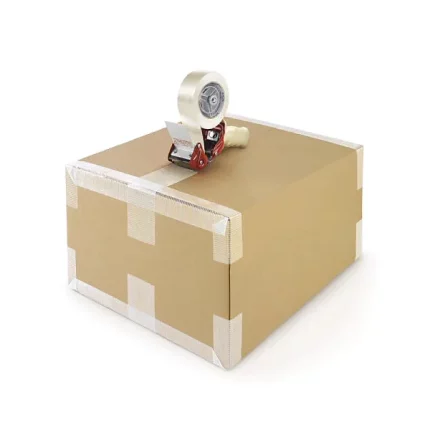
Cross-woven is the right choice when load stress is applied in multiple directions, or when the tape needs to hold across an irregular surface where the angle of tension changes.
The most common applications are securing irregularly shaped loads where the tape wraps around corners or curves, and reinforcing palletised loads where goods can shift laterally as well as vertically. It’s also used for in-transit securing of goods that experience movement in multiple directions during road or sea freight.
Cross-woven is also specified where the tape needs to be cut cleanly at an angle or torn across its width during application. The cross-direction fibres resist uncontrolled tearing and give a degree of manual tearability that mono construction doesn’t have.
If your load is long, regular and the stress is applied along a single axis, mono is the more efficient choice. It delivers higher peak tensile strength in that axis at a lower cost per roll than cross-woven.
If your load is irregular or the tape wraps around a surface at varying angles, cross-woven is the right specification. It’s also the right choice when you need resistance to tearing in more than one direction. The lower peak tensile strength in either single axis is offset by its performance under multi-directional load. The full packing tape range includes both constructions across the standard widths.
To learn more about these types of tapes and others, read our complete guide to adhesive tapes.
All filament-reinforced sealing is reinforced, but not all reinforced options use filament construction. Filament specifically refers to options with continuous glass fibre strands. Cross-woven uses fibres running in two directions. Reinforced is a broader category that includes cross-woven, reinforced kraft paper and other high-strength constructions.
It can seal box seams, but it’s primarily designed for bundling, strapping and load securing rather than standard box sealing. For heavy box sealing, reinforced gummed paper tape and Polypropylene Heavy Duty Tape are solid options.
Tensile strength varies by construction and width and is rated separately in the machine direction (along the length) and the cross direction (across the width) for cross-woven options. Check the product data sheet for the specific rating before specifying – figures vary across the range and shouldn’t be assumed.
The glass fibre reinforcement isn’t affected by low temperatures, but the adhesive will be. The filament options in the RAJAPACK range use an artificial hot melt rubber adhesive, rated for application at 15°C minimum. Below that, the adhesive loses tack and may not bond reliably. For cold storage applications, use a different construction with an acrylic adhesive see the polypropylene range for acrylic-adhesive options rated to lower temperatures or our gummed paper tape, which can be used at -10°C and is available in reinforced options.
These constructions can’t be torn by hand due to the continuous glass fibre strands. They require a cutter, scissors or a dispenser with an integrated cutting blade. Most industrial dispensers include a blade suitable for these constructions.
Common widths in the RAJAPACK range are 25mm, 48mm and 75mm. The narrower 25mm width suits bundling and corner reinforcement. The 48mm and 75mm widths are used for heavier pallet strapping and load securing where a larger adhesive contact area is needed. Note that 75mm is only stocked in the cross-woven 110-micron option, not the mono 90-micron.